Article Sidebar
Main Article Content
Abstract
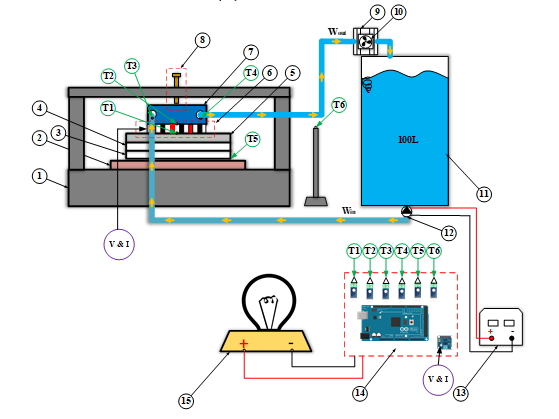
Advanced materials are used in thermoelectric generator (TEG) technology to turn heat into electricity using the Seebeck effect, which helps make better use of heat sources. The Seebeck effect is a result of the temperature disparity that exists between the two surfaces of the TEG. The configuration utilized in this investigation comprises several primary components, including the water block, thermoelectric, heat exchanger plate, and heater plate. The water block is positioned on the cold surface side of the thermoelectric to optimize the cooling process, while the heater plate is positioned on the surface side to facilitate the heating process. Initially, we position the heater plate to avoid direct contact between the heated surface side and the material plate. The plates consist of both copper and aluminum elements. This is done to facilitate the identification of the configuration systems, specifically TEG A (copper) and TEG B (aluminum). The research findings indicate that the TEG B configuration system, when subjected to a heating rate, yields superior voltage, current, and power outputs.
Keywords
Article Details

This work is licensed under a Creative Commons Attribution 4.0 International License.