Article Sidebar
Main Article Content
Abstract
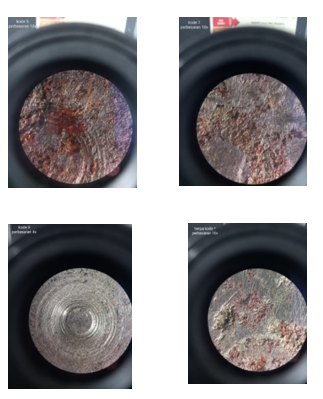
Corrosion resistance is a crucial factor in extending the service life of cast iron turbocharger components, particularly in corrosive environments. One effective approach to enhance corrosion resistance is through the pack carburizing process, which forms a protective carbon layer on the material’s surface. In this study, water hyacinth charcoal was utilized as an alternative carbon source due to its environmentally friendly and economical characteristics. The research aimed to evaluate the effect of varying pack carburizing durations on the corrosion resistance of cast iron turbochargers and to characterize the macrostructural changes on the surface resulting from the treatment. The methodology involved a pack carburizing process with holding times of 2, 4, and 6 hours at a controlled temperature, followed by electrochemical corrosion testing. Macrostructural characterization was also conducted to observe surface morphology changes due to carbon diffusion. The test results showed that the untreated specimen had a corrosion rate of 0.180 mm/y, which decreased to 0.120 mm/y after 2 hours of carburizing. A more significant reduction was observed in the 4-hour specimen, with a corrosion rate of 0.095 mm/y, representing a 47% decrease compared to the untreated sample. However, after 6 hours, the corrosion rate only slightly decreased to 0.090 mm/y, indicating that the carbon layer had reached saturation. Macrostructural observations confirmed the formation of a more homogeneous carbon layer in the 4-hour specimen, while the 6-hour specimen exhibited a thicker layer with diminishing protective effectiveness. This study demonstrates that pack carburizing using water hyacinth charcoal can significantly enhance the corrosion resistance of cast iron turbochargers, with an optimal treatment duration of 4 hours for maximum protection.
Keywords: pack carburizing, water hyacinth charcoal, cast iron, corrosion resistance, mechanical properties
Keywords
Article Details

This work is licensed under a Creative Commons Attribution 4.0 International License.
References
- Asri, M., et al. (2020). Effect of biomass-based carburizing on steelproperties. Materials Science
- Forum, 987, 123130.
- Callister, W.D., & Rethwisch, D.G. (2020). Materials Science and Engineering: An Introduction
- (10th ed.). Hoboken: John Wiley & Sons.
- Gupta, R., & Singh, A. (2022). Corrosion resistance of carburized steels. Surface and Coatings
- Technology, 432, 128-137.
- Jaya, A., & Fitriani, D. (2023). Enceng gondok as alternative carbon source. Journal of Renewable
- Biomass, 12(3), 45-53.
- Jaya, A., & Fitriani, D. (2023). Pengaruh Media Karbon Berbasis Biomassa terhadap Efisiensi Proses
- Karburisasi Padat pada Baja Karbon Rendah. Jurnal Teknologi dan Aplikasi Material, 15(2),
- 77–84.
- Jaya, A., & Fitriani, R. (2023). Utilization of Biomass-Based Carbon Media for Surface Hardening
- and Corrosion Resistance Enhancement of Cast Iron. Indonesian Journal of Mechanical
- Engineering, 15(2), 89-97.
- Siregar, A., et al. (2020). Carburizing kinetics on iron alloys. Metallurgical Transactions A, 51(3),
- 456-467.
- Wang, T., et al. (2021). Surface hardening of cast iron. International Journal of Cast Metals
- Research, 34(5), 298-306.
- Wang, X., Li, Y., Zhang, T., & Chen, H. (2020). Effect of Carburizing Treatment on Corrosion
- Resistance of Cast Iron in Electrochemical Environment. Journal of Materials Science &
- Technology, 36(5), 1023-1032.
- Wang, X., Li, Z., & Zhou, Y. (2020). Effect of Carbonized Layer from Pack Carburizing on the
- Corrosion Resistance of Grey Cast Iron. Journal of Surface Engineering and Applied
- Electrochemistry, 56(3), 291–298.
- Zhang, L., & Wang, Y. (2021). Sustainable carburizing using agricultural waste. Journal of
- Materials Processing Technology, 293,117035.
References
Asri, M., et al. (2020). Effect of biomass-based carburizing on steelproperties. Materials Science
Forum, 987, 123130.
Callister, W.D., & Rethwisch, D.G. (2020). Materials Science and Engineering: An Introduction
(10th ed.). Hoboken: John Wiley & Sons.
Gupta, R., & Singh, A. (2022). Corrosion resistance of carburized steels. Surface and Coatings
Technology, 432, 128-137.
Jaya, A., & Fitriani, D. (2023). Enceng gondok as alternative carbon source. Journal of Renewable
Biomass, 12(3), 45-53.
Jaya, A., & Fitriani, D. (2023). Pengaruh Media Karbon Berbasis Biomassa terhadap Efisiensi Proses
Karburisasi Padat pada Baja Karbon Rendah. Jurnal Teknologi dan Aplikasi Material, 15(2),
77–84.
Jaya, A., & Fitriani, R. (2023). Utilization of Biomass-Based Carbon Media for Surface Hardening
and Corrosion Resistance Enhancement of Cast Iron. Indonesian Journal of Mechanical
Engineering, 15(2), 89-97.
Siregar, A., et al. (2020). Carburizing kinetics on iron alloys. Metallurgical Transactions A, 51(3),
456-467.
Wang, T., et al. (2021). Surface hardening of cast iron. International Journal of Cast Metals
Research, 34(5), 298-306.
Wang, X., Li, Y., Zhang, T., & Chen, H. (2020). Effect of Carburizing Treatment on Corrosion
Resistance of Cast Iron in Electrochemical Environment. Journal of Materials Science &
Technology, 36(5), 1023-1032.
Wang, X., Li, Z., & Zhou, Y. (2020). Effect of Carbonized Layer from Pack Carburizing on the
Corrosion Resistance of Grey Cast Iron. Journal of Surface Engineering and Applied
Electrochemistry, 56(3), 291–298.
Zhang, L., & Wang, Y. (2021). Sustainable carburizing using agricultural waste. Journal of
Materials Processing Technology, 293,117035.