Article Sidebar
Main Article Content
Abstract
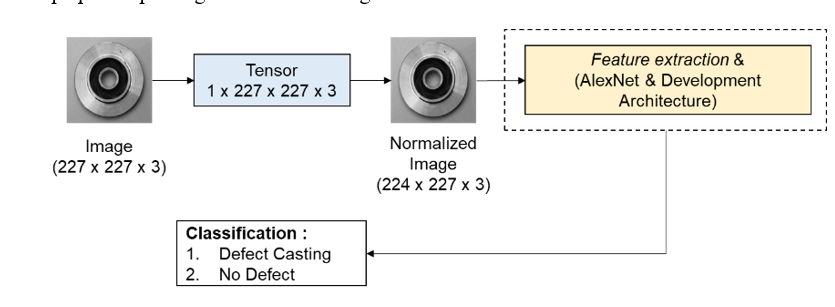
Untuk mencegah faktor subjektivitas dan potensi human error saat pengecekan kualitas produk casting manufacturing secara manual, penelitian ini bertujuan mengembangkan sistem Automated Visual Inspection (AVI) berbasis AI. Metode yang digunakan dengan pendekatan Deep learning berbasis Convolutional Neural Network (CNN) dengan membandingkan kinerja antara arsitektur AlexNet dan Development architecture. Proses evaluasi menggunakan 6.633 citra riil hasil preprocessing yang terbagi atas kelas defect dan non-defect untuk data training dan validasi. Hasil eksperimen membuktikan keunggulan architecture AlexNet yang mencatatkan akurasi hingga 99,25% dengan validation loss sebesar 0,02481, sementara architecture pengembangan hanya menghasilkan tingkat akurasi 89,07%. Hasil analisis confusion matrix juga memperlihatkan tingkat kestabilan AlexNet yang sangat tinggi dengan nilai presisi, recall, serta F1-score melebihi 0,99. Kesimpulan dari penelitian ini menegaskan bahwa architecture AlexNet memiliki efektivitas yang jauh lebih tinggi dalam mendeteksi cacat pada komponen pengecoran logam, menjadikannya opsi yang sangat relevan untuk diaplikasikan dalam sistem kendali mutu otomatis di industri.
Keywords
Article Details

This work is licensed under a Creative Commons Attribution 4.0 International License.
References
- Chen, X., Chen, J., Han, X., Zhao, C., Zhang, D., Zhu, K., & Su, Y. (2020). A Light-Weighted CNN Model for Wafer Structural Defect Detection. IEEE Access, 8, 24006–24018. https://doi.org/10.1109/ACCESS.2020.2970461
- Fei, Z., Yang, E., Yu, L., Li, X., Zhou, H., & Zhou, W. (2022). A Novel deep neural network-based emotion analysis system for automatic detection of mild cognitive impairment in the elderly. Neurocomputing, 468, 306–316. https://doi.org/10.1016/j.neucom.2021.10.038
- Gonzalez, R. C. , & W. R. E. (2008). Digital Image Processing (3rd ed.). Pearson Prentice Hall. (Vol. 3rd).
- He, K., Zhang, X., Ren, S., & Sun, J. (2016). Deep Residual Learning for Image Recognition. 2016 IEEE Conference on Computer Vision and Pattern Recognition (CVPR), 770–778. https://doi.org/10.1109/CVPR.2016.90
- Hou, M., Li, P., Cheng, S., & Yv, J. (2024). CNN‐based defect detection in manufacturing. Advanced Control for Applications, 6(4). https://doi.org/10.1002/adc2.196
- Krizhevsky, A. , S. I. , & H. G. E. (2012). ImageNet classification with deep Convolutional Neural Networks.
- LeCun, Y., Bengio, Y., & Hinton, G. (2015). Deep learning. Nature, 521(7553), 436–444. https://doi.org/10.1038/nature14539
- Park, S.-H., Lee, K.-H., Park, J.-S., & Shin, Y.-S. (2022). Deep Learning-Based Defect Detection for Sustainable Smart Manufacturing. Sustainability, 14(5), 2697. https://doi.org/10.3390/su14052697
- Shi, H., Ouyang, Q., Wang, X., Yang, Y., Song, T., Hao, J., & Huang, X. (2022). Insight into the formation of conjugated ladder structure of polyacrylonitrile by X-ray photoelectron spectroscopy. Measurement, 200, 111565. https://doi.org/10.1016/j.measurement.2022.111565
- Shi, R., Yu, X., Chen, H., Jiao, Y., Chen, J., Chen, F., & He, S. (2023). Research on the behaviour and mechanism of void welding based on multiple scales. High Temperature Materials and Processes, 42(1). https://doi.org/10.1515/htmp-2022-0271
- Tan, M., & Le, Q. V. (2020). EfficientNet: Rethinking Model Scaling for Convolutional Neural Networks.
- Wang, S., Xia, X., Ye, L., & Yang, B. (2021). Automatic Detection and Classification of Steel Surface Defect Using Deep Convolutional Neural Networks. Metals, 11(3), 388. https://doi.org/10.3390/met11030388
- Yu, Q., Yang, H., Lin, K.-Y., & Li, L. (2021). A self-organized approach for scheduling semiconductor manufacturing systems. Journal of Intelligent Manufacturing, 32(3), 689–706. https://doi.org/10.1007/s10845-020-01678-8
References
Chen, X., Chen, J., Han, X., Zhao, C., Zhang, D., Zhu, K., & Su, Y. (2020). A Light-Weighted CNN Model for Wafer Structural Defect Detection. IEEE Access, 8, 24006–24018. https://doi.org/10.1109/ACCESS.2020.2970461
Fei, Z., Yang, E., Yu, L., Li, X., Zhou, H., & Zhou, W. (2022). A Novel deep neural network-based emotion analysis system for automatic detection of mild cognitive impairment in the elderly. Neurocomputing, 468, 306–316. https://doi.org/10.1016/j.neucom.2021.10.038
Gonzalez, R. C. , & W. R. E. (2008). Digital Image Processing (3rd ed.). Pearson Prentice Hall. (Vol. 3rd).
He, K., Zhang, X., Ren, S., & Sun, J. (2016). Deep Residual Learning for Image Recognition. 2016 IEEE Conference on Computer Vision and Pattern Recognition (CVPR), 770–778. https://doi.org/10.1109/CVPR.2016.90
Hou, M., Li, P., Cheng, S., & Yv, J. (2024). CNN‐based defect detection in manufacturing. Advanced Control for Applications, 6(4). https://doi.org/10.1002/adc2.196
Krizhevsky, A. , S. I. , & H. G. E. (2012). ImageNet classification with deep Convolutional Neural Networks.
LeCun, Y., Bengio, Y., & Hinton, G. (2015). Deep learning. Nature, 521(7553), 436–444. https://doi.org/10.1038/nature14539
Park, S.-H., Lee, K.-H., Park, J.-S., & Shin, Y.-S. (2022). Deep Learning-Based Defect Detection for Sustainable Smart Manufacturing. Sustainability, 14(5), 2697. https://doi.org/10.3390/su14052697
Shi, H., Ouyang, Q., Wang, X., Yang, Y., Song, T., Hao, J., & Huang, X. (2022). Insight into the formation of conjugated ladder structure of polyacrylonitrile by X-ray photoelectron spectroscopy. Measurement, 200, 111565. https://doi.org/10.1016/j.measurement.2022.111565
Shi, R., Yu, X., Chen, H., Jiao, Y., Chen, J., Chen, F., & He, S. (2023). Research on the behaviour and mechanism of void welding based on multiple scales. High Temperature Materials and Processes, 42(1). https://doi.org/10.1515/htmp-2022-0271
Tan, M., & Le, Q. V. (2020). EfficientNet: Rethinking Model Scaling for Convolutional Neural Networks.
Wang, S., Xia, X., Ye, L., & Yang, B. (2021). Automatic Detection and Classification of Steel Surface Defect Using Deep Convolutional Neural Networks. Metals, 11(3), 388. https://doi.org/10.3390/met11030388
Yu, Q., Yang, H., Lin, K.-Y., & Li, L. (2021). A self-organized approach for scheduling semiconductor manufacturing systems. Journal of Intelligent Manufacturing, 32(3), 689–706. https://doi.org/10.1007/s10845-020-01678-8