Article Sidebar
Main Article Content
Abstract
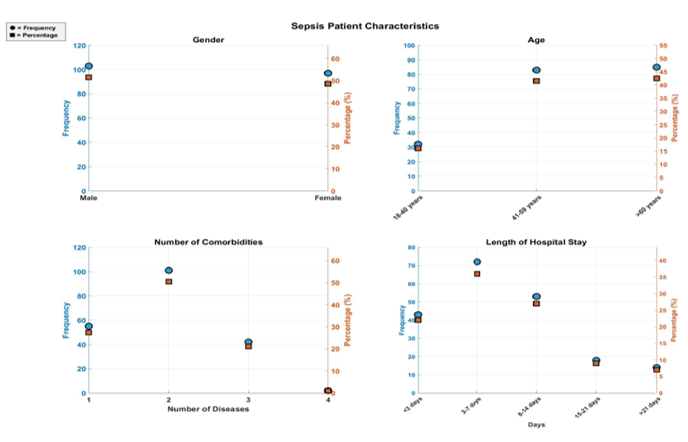
Sepsis remains a critical global health challenge requiring prompt and appropriate antimicrobial intervention to reduce mortality. Despite established guidelines recommending early broad-spectrum antibiotic administration, empirical prescribing patterns and their alignment with clinical recommendations remain insufficiently documented in Indonesian multicenter settings, particularly in Central Java. This study addresses the knowledge gap by evaluating antibiotic utilization profiles and patient characteristics among hospitalized sepsis cases in Semarang, with emphasis on empirical therapy practices and stewardship implications. A multicenter retrospective observational study was conducted involving 200 sepsis patients meeting predefined inclusion criteria from two hospitals in Semarang during 2019–2023. Data were extracted from medical records and analyzed descriptively, considering inter-hospital variability in prescribing practices. Results demonstrated male predominance (51.5%), elderly population representation (42.5% aged >60 years), multiple comorbidity burden (50.5% with two comorbidities), and moderate hospitalization duration (36% for 3–7 days). Broad-spectrum agents active against both Gram-positive and Gram-negative organisms dominated prescribing patterns (89.4%), while time-dependent antibiotics represented 10.5% of prescriptions. Meropenem emerged as the most frequently prescribed agent (33.3%), administered exclusively via the intravenous route (100%). These findings underscore the importance of structured antimicrobial management and robust de-escalation strategies in local hospital settings to effectively balance necessary empirical coverage with the prevention of antimicrobial resistance
Article Details

This work is licensed under a Creative Commons Attribution 4.0 International License.
References
- Abe, T., Iriyama, H., Imaeda, T., Komori, A., Oami, T., Aizimu, T., Takahashi, N., Yamao, Y., Nakagawa, S., Ogura, H., Umemura, Y., Matsushima, A., Fushimi, K., Shime, N., & Nakada, T. aki. (2024). Epidemiology and patterns of empiric antimicrobial therapy practice in patients with community-onset sepsis using data from a Japanese nationwide medical claims database —the Japan Sepsis Alliance (JaSA) study group. IJID Regions, 10(January), 162–167. https://doi.org/10.1016/j.ijregi.2024.01.002
- Anggraeni, R., Arozal, W., Sumiyati, Y., & Rejeki, M. S. (2024). Evaluation Of Antibiotic Use In Sepsis Patients In The ICU Treatment Room , Gatot Soebroto Rspad Period January 2020 – December 2021. 13(02), 874–884. https://doi.org/10.54209/ekonomi.v13i02
- Bowen D, Hughes T, Juliebø-Jones P, Somani B. Fournier’s gangrene: a review of predictive scoring systems and practical guide for patient management. Ther Adv Infect Dis 2024;11. https://doi.org/10.1177/20499361241238521
- Cory, D., Leiwakabessy, B., Yulia, R., & Herawati, F. (2024). ANALISIS PENGGUNAAN ANTIBIOTIK PADA PASIEN SEPSIS DI INTENSIVE CARE UNIT ( ICU ) RSI SURABAYA JEMURSARI The Analysis of Antibiotic Use for Sepsis Patient in Intensive Care Unit of RSI Jemursari Surabaya. Jurnal Kesehatan Madani Medika, 15(01), 67–76.
- Evans, L., Rhodes, A., Alhazzani, W., Antonelli, M., Coopersmith, C. M., French, C., Machado, F. R., Mcintyre, L., Ostermann, M., Prescott, H. C., Schorr, C., Simpson, S., Wiersinga, W. J., Alshamsi, F., Angus, D. C., Arabi, Y., Azevedo, L., Beale, R., Beilman, G., … Levy, M. (2021). Surviving sepsis campaign: international guidelines for management of sepsis and septic shock 2021. Intensive Care Medicine, 47(11), 1181–1247. https://doi.org/10.1007/s00134-021-06506-y
- Farizi GR Al, Vidiani AAPP, Gloria F, Karlina D, Astuti EB. The Quality Evaluation of Antibiotics for the Treatment of Diabetic Foot Ulcers in the Intensive Care Unit of Public Private Hospital, Semarang City. J Pharmacol Pharmacother 2025;16:274–82. https://doi.org/10.1177/0976500X241306180
- Farizi, G. R. A., Gloria, F., & Maharani, R. (2024). Evaluation of antibiotic use in pediatric pneumonia patients using ATC/DDD and Gyssens methods at Primaya Hospital Semarang. Jurnal Ilmu Farmasi dan Farmasi Klinik (JIFFK), 21(2), 140–149. https://doi.org/10.31942/jiffk.v21i2.9460
- Harsini, H., Alfarizi, A., Aphridasari, J., Raharjo, A. F., & Reviono, R. (2024). Comparison of NEWS, SIRS, and qSOFA Score as Predictors of Mortality and Length of Stay in Patients Pneumonia with Sepsis. Jurnal Respirologi Indonesia, 44(1), 45–52. https://doi.org/10.36497/jri.v44i1.505
- Jiang, W., Song, L., Zhang, Y., Ba, J., Yuan, J., Li, X., Liao, T., Zhang, C., Shao, J., Yu, J., & Zheng, R. (2024). The influence of gender on the epidemiology of and outcome from sepsis associated acute kidney injury in ICU: a retrospective propensity-matched cohort study. European Journal of Medical Research, 29(1), 1–13. https://doi.org/10.1186/s40001-024-01651-8
- Kang, C., Choi, S., Jang, E. J., Joo, S., Jeong, J. H., Oh, S. Y., Ryu, H. G., & Lee, H. (2024). Prevalence and outcomes of chronic comorbid conditions in patients with sepsis in Korea: a nationwide cohort study from 2011 to 2016. BMC Infectious Diseases, 24(1), 1–11. https://doi.org/10.1186/s12879-024-09081-x
- Kobayashi, K., Hata, A., Imoto, W., Kakuno, S., Shibata, W., Yamada, K., Kawaguchi, H., Sakurai, N., Nakaie, K., Nakatsuka, Y., Ito, T., Uenoyama, K., Takahashi, T., Ueda, S., Katayama, T., Onoue, M., & Kakeya, H. (2023). The Clinical Evaluation of Third-generation Cephalosporins As Definitive Therapy for Enterobacter spp. and Klebsiella aerogenes Bacteremia. Internal Medicine, 62(13), 1921–1929. https://doi.org/10.2169/internalmedicine.0612-22
- Lakoh S, Williams CEE, Sevalie S, Russell JBW, Conteh SK, Kanu JS, et al. Antibiotic use and consumption among medical patients of two hospitals in Sierra Leone: a descriptive report. BMC Infect Dis 2023;23:737. https://doi.org/10.1186/s12879-023-08517-0
- Low, D. E. (1993). Assessment of the use of cefixime for switch therapy. Infection, 21(2), 102–104. https://doi.org/10.1007/BF01742992
- Li, Y., Guo, J., Yang, H., Li, H., Shen, Y., & Zhang, D. (2021). Comparison of culture-negative and culture-positive sepsis or septic shock: a systematic review and meta-analysis. Critical Care, 25(1), 1–9. https://doi.org/10.1186/s13054-021-03592-8
- Lipsky, B. A., Aragón-Sánchez, J., Diggle, M., Embil, J., Kono, S., Lavery, L., Senneville, É., Urbančič-Rovan, V., Van Asten, S., & Peters, E. J. G. (2020). IWGDF guidance on the diagnosis and management of foot infections in persons with diabetes. Diabetes/Metabolism Research and Reviews, 36(S1), e2699. https://doi.org/10.1002/dmrr.2699
- Mellhammar, L., Kahn, F., Whitlow, C., Kander, T., Christensson, B., & Linder, A. (2021). Bacteremic sepsis leads to higher mortality when adjusting for confounders with propensity score matching. Scientific Reports, 11(1), 1–12. https://doi.org/10.1038/s41598-021-86346-4
- Pacifici GM, Marchini G. Clinical pharmacology of ceftriaxone in neonates and infants: Effects and pharmacokinetics. Int J Pediatr 2017;5:5751–78. https://doi.org/10.22038/ijp.2017.25371.2155Pandey, M., & Cascella, M. (2022). Beta Lactam Antibiotics - PubMed. September, 1–7.
- Peraturan Mentri Kesehatan Republik Indonesia. (2021). Pedoman Penggunaan Antibiotik. Permenkes RI, 1–97.
- Peraturan Mentri Kesehatan Republik Indonesia. (2015). Regulation of the Minister of Health of the Republic of Indonesia Number 8 of 2015 concerning the Antimicrobial Resistance Control Program in Hospitals. https://peraturan.bpk.go.id/Details/114886/permenkes-no-8-tahun-2015
- Purnamasari, D., Yasin, N. M., & Andayani, T. M. (2025). Evaluasi Penggunaan Antibiotik Empiris pada Pasien Sepsis di Intensive Care Unit RSUD Dr. H. Abdul Moeloek Provinsi Lampung. Jurnal Surya Medika, 11(2), 103–109. https://doi.org/10.33084/jsm.v11i2.8683
- Risalati, P., AlFarizi, G. R., Lusia, P., & Aurelia, R. (2022). Case study: The investigation of drug-induced liver injury in an in-patient of the internal medicine ward. In Proceedings of the 3rd International Conference on Health Practice and Research (ICHPR). STIKES Telogorejo Semarang. http://ojs.stikestelogorejo.ac.id/index.php/ichpr/article/view/263
- Rohman, A. F., Radji, M., Rianti, A., & Rachman, A. (2023). Evaluation of the Use of Antibiotics on Therapy Results of Sepsis Patients in the Intensive Care Unit (ICU) of Fatmawati Hospital, Jakarta. Journal of Medicinal and Chemical Sciences, 7(1), 262–274. https://doi.org/10.26655/JMCHEMSCI.2024.1.25
- Sanjaya, B. D., Djuang, M. H., Muniro, F. D., & Chiuman, L. (2022). Sepsis Risk Factors in Elderly Patients At Royal Prima Medan General Hospital. Jambura Journal of Health Sciences and Research, 4(3), 596–603. https://doi.org/10.35971/jjhsr.v4i3.12488
- Senneville É, Albalawi Z, van Asten SA, Abbas ZG, Allison G, Aragón‐Sánchez J, et al. IWGDF/IDSA guidelines on the diagnosis and treatment of diabetes‐related foot infections (IWGDF/IDSA 2023). Diabetes Metab Res Rev 2024;40. https://doi.org/10.1002/dmrr.3687
- Sinapidis, D., Kosmas, V., Vittoros, V., Koutelidakis, I. M., Pantazi, A., Stefos, A., Katsaros, K. E., Akinosoglou, K., Bristianou, M., Toutouzas, K., Chrisofos, M., & Giamarellos-Bourboulis, E. J. (2018). Progression into sepsis: An individualized process varying by the interaction of comorbidities with the underlying infection. BMC Infectious Diseases, 18(1), 1–9. https://doi.org/10.1186/s12879-018-3156-z
- Singer, M., Deutschman, C. S., & Seymour. (2016). The third international consensus definitions for sepsis and septic shock (sepsis-3). JAMA - Journal of the American Medical Association, 801–810. https://doi.org/10.1001/jama.2016.0287
- Strich, J. R., Heil, E. L., & Masur, H. (2021). Considerations for empiric antimicrobial therapy in sepsis and septic shock in an era of antimicrobial resistance. Journal of Infectious Diseases, 222(Suppl 2), S119–S131. https://doi.org/10.1093/INFDIS/JIAA221
- Subhan., A., O., A., H., A. F., & KW, T. (2024). Pola Penggunaan Antibiotik Reserve Di Unit Intensif Dan Non Intensif Rawat Inap Rsup Fatmawati Usage Patterns Ofreserve Antibiotics Inthe Intensive Care Unitand Nonintensive Inpatientwards At Fatmawati Hospital. 3(1), 36–46.
- Sulaiman, H., Roberts, J. A., & Abdul-Aziz, M. H. (2022). Pharmacokinetics and pharmacodynamics of beta-lactam antibiotics in critically ill patients. Farmacia Hospitalaria, 46(3), 182–190. https://doi.org/10.7399/fh.13170
- Sultana, R., Ahmed, I., Saima, S., Salam, M. T., & Sultana, S. (2023). Diabetic foot ulcer—a systematic review on relevant microbial etiology and antibiotic resistance in Asian countries. Diabetes & Metabolic Syndrome: Clinical Research & Reviews, 17(4), 102783. https://doi.org/10.1016/j.dsx.2023.102783
- Thomas, A. P., Kumar, M., Johnson, R., More, S. P., & Panda, B. K. (2021). Evaluation of antibiotic consumption and compliance to hospital antibiotic policy in the surgery, orthopedics and gynecology wards of a tertiary care hospital. Clinical Epidemiology and Global Health, 12, 100944. https://doi.org/10.1016/j.cegh.2021.100944
- Thy, M., Timsit, J. F., & de Montmollin, E. (2023). Aminoglycosides for the Treatment of Severe Infection Due to Resistant Gram-Negative Pathogens. Antibiotics, 12(5), 1–14. https://doi.org/10.3390/antibiotics12050860
- Titiesari, Y. D., & Febriani, F. (2021). Optimasi Penggunaan Antimikroba Bagi Pasien Sepsis Berdasarkan Karakteristik Farmakokinetik Dan Farmakodinamik Obat: Sebuah Tinjauan Literatur. JFIOnline | Print ISSN 1412-1107 | e-ISSN 2355-696X, 13(1), 54–61. https://doi.org/10.35617/jfionline.v13i1.48
References
Abe, T., Iriyama, H., Imaeda, T., Komori, A., Oami, T., Aizimu, T., Takahashi, N., Yamao, Y., Nakagawa, S., Ogura, H., Umemura, Y., Matsushima, A., Fushimi, K., Shime, N., & Nakada, T. aki. (2024). Epidemiology and patterns of empiric antimicrobial therapy practice in patients with community-onset sepsis using data from a Japanese nationwide medical claims database —the Japan Sepsis Alliance (JaSA) study group. IJID Regions, 10(January), 162–167. https://doi.org/10.1016/j.ijregi.2024.01.002
Anggraeni, R., Arozal, W., Sumiyati, Y., & Rejeki, M. S. (2024). Evaluation Of Antibiotic Use In Sepsis Patients In The ICU Treatment Room , Gatot Soebroto Rspad Period January 2020 – December 2021. 13(02), 874–884. https://doi.org/10.54209/ekonomi.v13i02
Bowen D, Hughes T, Juliebø-Jones P, Somani B. Fournier’s gangrene: a review of predictive scoring systems and practical guide for patient management. Ther Adv Infect Dis 2024;11. https://doi.org/10.1177/20499361241238521
Cory, D., Leiwakabessy, B., Yulia, R., & Herawati, F. (2024). ANALISIS PENGGUNAAN ANTIBIOTIK PADA PASIEN SEPSIS DI INTENSIVE CARE UNIT ( ICU ) RSI SURABAYA JEMURSARI The Analysis of Antibiotic Use for Sepsis Patient in Intensive Care Unit of RSI Jemursari Surabaya. Jurnal Kesehatan Madani Medika, 15(01), 67–76.
Evans, L., Rhodes, A., Alhazzani, W., Antonelli, M., Coopersmith, C. M., French, C., Machado, F. R., Mcintyre, L., Ostermann, M., Prescott, H. C., Schorr, C., Simpson, S., Wiersinga, W. J., Alshamsi, F., Angus, D. C., Arabi, Y., Azevedo, L., Beale, R., Beilman, G., … Levy, M. (2021). Surviving sepsis campaign: international guidelines for management of sepsis and septic shock 2021. Intensive Care Medicine, 47(11), 1181–1247. https://doi.org/10.1007/s00134-021-06506-y
Farizi GR Al, Vidiani AAPP, Gloria F, Karlina D, Astuti EB. The Quality Evaluation of Antibiotics for the Treatment of Diabetic Foot Ulcers in the Intensive Care Unit of Public Private Hospital, Semarang City. J Pharmacol Pharmacother 2025;16:274–82. https://doi.org/10.1177/0976500X241306180
Farizi, G. R. A., Gloria, F., & Maharani, R. (2024). Evaluation of antibiotic use in pediatric pneumonia patients using ATC/DDD and Gyssens methods at Primaya Hospital Semarang. Jurnal Ilmu Farmasi dan Farmasi Klinik (JIFFK), 21(2), 140–149. https://doi.org/10.31942/jiffk.v21i2.9460
Harsini, H., Alfarizi, A., Aphridasari, J., Raharjo, A. F., & Reviono, R. (2024). Comparison of NEWS, SIRS, and qSOFA Score as Predictors of Mortality and Length of Stay in Patients Pneumonia with Sepsis. Jurnal Respirologi Indonesia, 44(1), 45–52. https://doi.org/10.36497/jri.v44i1.505
Jiang, W., Song, L., Zhang, Y., Ba, J., Yuan, J., Li, X., Liao, T., Zhang, C., Shao, J., Yu, J., & Zheng, R. (2024). The influence of gender on the epidemiology of and outcome from sepsis associated acute kidney injury in ICU: a retrospective propensity-matched cohort study. European Journal of Medical Research, 29(1), 1–13. https://doi.org/10.1186/s40001-024-01651-8
Kang, C., Choi, S., Jang, E. J., Joo, S., Jeong, J. H., Oh, S. Y., Ryu, H. G., & Lee, H. (2024). Prevalence and outcomes of chronic comorbid conditions in patients with sepsis in Korea: a nationwide cohort study from 2011 to 2016. BMC Infectious Diseases, 24(1), 1–11. https://doi.org/10.1186/s12879-024-09081-x
Kobayashi, K., Hata, A., Imoto, W., Kakuno, S., Shibata, W., Yamada, K., Kawaguchi, H., Sakurai, N., Nakaie, K., Nakatsuka, Y., Ito, T., Uenoyama, K., Takahashi, T., Ueda, S., Katayama, T., Onoue, M., & Kakeya, H. (2023). The Clinical Evaluation of Third-generation Cephalosporins As Definitive Therapy for Enterobacter spp. and Klebsiella aerogenes Bacteremia. Internal Medicine, 62(13), 1921–1929. https://doi.org/10.2169/internalmedicine.0612-22
Lakoh S, Williams CEE, Sevalie S, Russell JBW, Conteh SK, Kanu JS, et al. Antibiotic use and consumption among medical patients of two hospitals in Sierra Leone: a descriptive report. BMC Infect Dis 2023;23:737. https://doi.org/10.1186/s12879-023-08517-0
Low, D. E. (1993). Assessment of the use of cefixime for switch therapy. Infection, 21(2), 102–104. https://doi.org/10.1007/BF01742992
Li, Y., Guo, J., Yang, H., Li, H., Shen, Y., & Zhang, D. (2021). Comparison of culture-negative and culture-positive sepsis or septic shock: a systematic review and meta-analysis. Critical Care, 25(1), 1–9. https://doi.org/10.1186/s13054-021-03592-8
Lipsky, B. A., Aragón-Sánchez, J., Diggle, M., Embil, J., Kono, S., Lavery, L., Senneville, É., Urbančič-Rovan, V., Van Asten, S., & Peters, E. J. G. (2020). IWGDF guidance on the diagnosis and management of foot infections in persons with diabetes. Diabetes/Metabolism Research and Reviews, 36(S1), e2699. https://doi.org/10.1002/dmrr.2699
Mellhammar, L., Kahn, F., Whitlow, C., Kander, T., Christensson, B., & Linder, A. (2021). Bacteremic sepsis leads to higher mortality when adjusting for confounders with propensity score matching. Scientific Reports, 11(1), 1–12. https://doi.org/10.1038/s41598-021-86346-4
Pacifici GM, Marchini G. Clinical pharmacology of ceftriaxone in neonates and infants: Effects and pharmacokinetics. Int J Pediatr 2017;5:5751–78. https://doi.org/10.22038/ijp.2017.25371.2155Pandey, M., & Cascella, M. (2022). Beta Lactam Antibiotics - PubMed. September, 1–7.
Peraturan Mentri Kesehatan Republik Indonesia. (2021). Pedoman Penggunaan Antibiotik. Permenkes RI, 1–97.
Peraturan Mentri Kesehatan Republik Indonesia. (2015). Regulation of the Minister of Health of the Republic of Indonesia Number 8 of 2015 concerning the Antimicrobial Resistance Control Program in Hospitals. https://peraturan.bpk.go.id/Details/114886/permenkes-no-8-tahun-2015
Purnamasari, D., Yasin, N. M., & Andayani, T. M. (2025). Evaluasi Penggunaan Antibiotik Empiris pada Pasien Sepsis di Intensive Care Unit RSUD Dr. H. Abdul Moeloek Provinsi Lampung. Jurnal Surya Medika, 11(2), 103–109. https://doi.org/10.33084/jsm.v11i2.8683
Risalati, P., AlFarizi, G. R., Lusia, P., & Aurelia, R. (2022). Case study: The investigation of drug-induced liver injury in an in-patient of the internal medicine ward. In Proceedings of the 3rd International Conference on Health Practice and Research (ICHPR). STIKES Telogorejo Semarang. http://ojs.stikestelogorejo.ac.id/index.php/ichpr/article/view/263
Rohman, A. F., Radji, M., Rianti, A., & Rachman, A. (2023). Evaluation of the Use of Antibiotics on Therapy Results of Sepsis Patients in the Intensive Care Unit (ICU) of Fatmawati Hospital, Jakarta. Journal of Medicinal and Chemical Sciences, 7(1), 262–274. https://doi.org/10.26655/JMCHEMSCI.2024.1.25
Sanjaya, B. D., Djuang, M. H., Muniro, F. D., & Chiuman, L. (2022). Sepsis Risk Factors in Elderly Patients At Royal Prima Medan General Hospital. Jambura Journal of Health Sciences and Research, 4(3), 596–603. https://doi.org/10.35971/jjhsr.v4i3.12488
Senneville É, Albalawi Z, van Asten SA, Abbas ZG, Allison G, Aragón‐Sánchez J, et al. IWGDF/IDSA guidelines on the diagnosis and treatment of diabetes‐related foot infections (IWGDF/IDSA 2023). Diabetes Metab Res Rev 2024;40. https://doi.org/10.1002/dmrr.3687
Sinapidis, D., Kosmas, V., Vittoros, V., Koutelidakis, I. M., Pantazi, A., Stefos, A., Katsaros, K. E., Akinosoglou, K., Bristianou, M., Toutouzas, K., Chrisofos, M., & Giamarellos-Bourboulis, E. J. (2018). Progression into sepsis: An individualized process varying by the interaction of comorbidities with the underlying infection. BMC Infectious Diseases, 18(1), 1–9. https://doi.org/10.1186/s12879-018-3156-z
Singer, M., Deutschman, C. S., & Seymour. (2016). The third international consensus definitions for sepsis and septic shock (sepsis-3). JAMA - Journal of the American Medical Association, 801–810. https://doi.org/10.1001/jama.2016.0287
Strich, J. R., Heil, E. L., & Masur, H. (2021). Considerations for empiric antimicrobial therapy in sepsis and septic shock in an era of antimicrobial resistance. Journal of Infectious Diseases, 222(Suppl 2), S119–S131. https://doi.org/10.1093/INFDIS/JIAA221
Subhan., A., O., A., H., A. F., & KW, T. (2024). Pola Penggunaan Antibiotik Reserve Di Unit Intensif Dan Non Intensif Rawat Inap Rsup Fatmawati Usage Patterns Ofreserve Antibiotics Inthe Intensive Care Unitand Nonintensive Inpatientwards At Fatmawati Hospital. 3(1), 36–46.
Sulaiman, H., Roberts, J. A., & Abdul-Aziz, M. H. (2022). Pharmacokinetics and pharmacodynamics of beta-lactam antibiotics in critically ill patients. Farmacia Hospitalaria, 46(3), 182–190. https://doi.org/10.7399/fh.13170
Sultana, R., Ahmed, I., Saima, S., Salam, M. T., & Sultana, S. (2023). Diabetic foot ulcer—a systematic review on relevant microbial etiology and antibiotic resistance in Asian countries. Diabetes & Metabolic Syndrome: Clinical Research & Reviews, 17(4), 102783. https://doi.org/10.1016/j.dsx.2023.102783
Thomas, A. P., Kumar, M., Johnson, R., More, S. P., & Panda, B. K. (2021). Evaluation of antibiotic consumption and compliance to hospital antibiotic policy in the surgery, orthopedics and gynecology wards of a tertiary care hospital. Clinical Epidemiology and Global Health, 12, 100944. https://doi.org/10.1016/j.cegh.2021.100944
Thy, M., Timsit, J. F., & de Montmollin, E. (2023). Aminoglycosides for the Treatment of Severe Infection Due to Resistant Gram-Negative Pathogens. Antibiotics, 12(5), 1–14. https://doi.org/10.3390/antibiotics12050860
Titiesari, Y. D., & Febriani, F. (2021). Optimasi Penggunaan Antimikroba Bagi Pasien Sepsis Berdasarkan Karakteristik Farmakokinetik Dan Farmakodinamik Obat: Sebuah Tinjauan Literatur. JFIOnline | Print ISSN 1412-1107 | e-ISSN 2355-696X, 13(1), 54–61. https://doi.org/10.35617/jfionline.v13i1.48