Article Sidebar
Main Article Content
Abstract
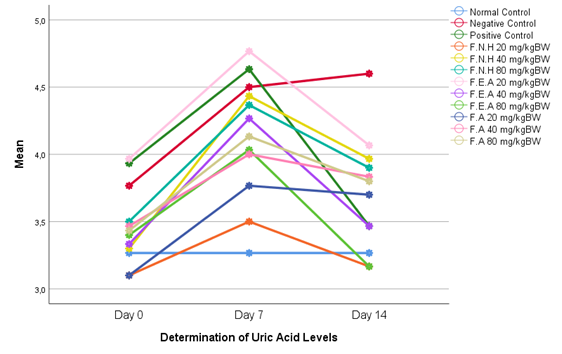
Hyperuricemia is a metabolic disorder characterised by elevated uric acid levels in the blood, which may lead to complications such as gout, arthritis, kidney stones, and renal failure. In recent years, medicinal plants have gained increasing attention as alternative therapies for hyperuricemia. Chromolaena odorata, commonly known as kirinyuh, is one such plant suspected to have antihyperuricemic properties. This study aimed to evaluate the antihyperuricemic activity of the n-hexane, ethyl acetate, and aqueous fractions of C. odorata leaf ethanol extract in male Swiss Webster mice induced with chicken liver juice. The extract was obtained by maceration using 96% ethanol and subsequently fractionated using solvents with different polarities. The experiment employed a pretest-posttest control group design, involving 12 groups: a normal control, a negative control (0.5% Na-CMC), a positive control (allopurinol at 13 mg/kg body weight), and nine treatment groups that received each fraction at doses of 20, 40, and 80 mg/kg body weight. Uric acid levels were measured at three intervals: baseline (day 0), post-induction (day 7), and after treatment (day 14), using the Easy Touch GCU Multi-Function Monitoring System. The results demonstrated that all three fractions reduced uric acid levels, with the ethyl acetate fraction at 80 mg/kg body weight (BW) showing the most significant effect, achieving a 21.34% reduction. These findings suggest that Chromolaena odorata leaves, especially the ethyl acetate fraction, possess promising antihyperuricemic potential and could serve as a natural alternative for managing hyperuricemia.
Article Details

This work is licensed under a Creative Commons Attribution 4.0 International License.