Article Sidebar
Main Article Content
Abstract
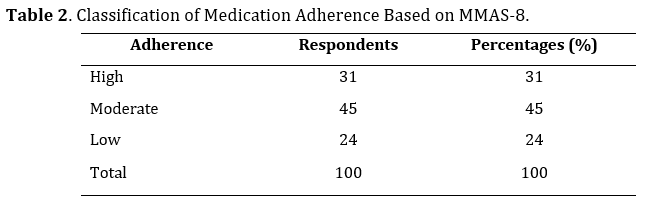
The increasing prevalence of stroke needs attention. Medication adherence and disease perception play an important role in stroke treatment. The research aimed to provide an overview of disease perception and medication adherence in stroke patients at Hospital X, Central Java Province. Quantitative research was conducted using cross-sectional. The study population was JKN stroke patients who received treatment during the study period. The sample used must meet the inclusion criteria such as being ≥18 years old, being willing to be a research subject, and having been diagnosed with stroke within 3 months. Adherence to medication using the Morisky Medication Adherence Scale questionnaire and understanding perceptions of illness using the Brief Illness Perception Questionnaire. Based on research data, the average respondent had experienced a stroke for 2.62 years with a history of diabetes mellitus, hypertension, cholesterol, heart disease, and gout. Perception of illness with a total score of 57.59 (> 40) which means the respondent has a positive perception. A total of 31 respondents had a high level of compliance, 45 respondents had a medium level of compliance, and 24 respondents had a low level of compliance. The research conclusion shows that the majority of patients have a good perception of the disease by carrying out pharmacological and non-pharmacological treatment such as adopting a healthy diet and living pattern, and regular exercise. Non-compliance with taking medication is caused by forgetting to take medication, stopping taking medication when side effects appear or feeling better, forgetting to bring medication when traveling, and still having difficulty remembering to use medication.
Article Details

This work is licensed under a Creative Commons Attribution 4.0 International License.