Article Sidebar
Main Article Content
Abstract
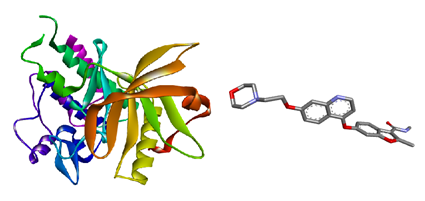
Liver cancer development is highly dependent on angiogenesis, the formation of new blood vessels that supply nutrients and oxygen to cancer cells, facilitating tumor growth and metastasis. Vascular Endothelial Growth Factor Receptor 2 (VEGFR2), a receptor tyrosine kinase, represents a promising anti-angiogenesis therapeutic target. Bioactive compounds from tulsi (Ocimum sanctum L.) possess potential anticancer properties, but their specific mechanisms against VEGFR2 in liver cancer require investigation. This study evaluated the interaction potential of tulsi bioactive compounds against VEGFR2 protein structure (PDB ID: 2XIR) through in silico molecular docking analysis. Drug-likeness evaluation was conducted based on Lipinski's rule of five and ADMET profiling. Molecular docking analysis revealed comparative binding performance between two tulsi compounds against VEGFR2. Cirsimaritin demonstrated significant inhibition potential with free binding energy (∆G) of -9.06 kcal/mol, inhibition constant (Ki) of 226.95 μM, and stabilizing interactions with residues PHE1047, VAL848, LEU840, and CYS1045. The native ligand exhibited superior binding affinity with ∆G of -12.68 kcal/mol and Ki of 508.94 pM, indicating greater therapeutic potential for anti-angiogenic liver cancer treatment. Overall, this study is useful for the development of the potential of tulsi bioactive compounds as angiogenesis inhibitors and alternative natural ingredient-based therapies for liver cancer. Further in vitro and in vivo studies are needed to validate the anticancer activity and mechanism of angiogenesis inhibition by these compounds.
Article Details

This work is licensed under a Creative Commons Attribution 4.0 International License.